Injuries are seldom positive, but looking on the bright side Rufus's has provided some husband/wife/horse bonding time.
 |
| Soak, soak, soak |
Along with that, I've also gotten the chance to use a few products on a long term basis that I otherwise might not have encountered. On the off chance that my experience might be helpful, I thought I'd review a few of them over the next few weeks.
 |
| New wrap |
I mentioned the
Hoof Wrap in my last post, as the final layer of protection that allows Rufus to be out and about with the herd. He's been wearing one 24x7 for the last going-on-four months -
a pretty fair test of usefulness and durability.
- What it is: the name actually describes it well. It's a soft, easy-on, plasticy/canvas wrap with hook & loop fasteners and a removable pad.
- What it does: protects the sole and hoof (and any injuries) from the ground.
- How to put them on: Remove the backing from the velcro squares, attach the pad to the wrap, and then just follow the numbered tabs. After multiple applications, I found actually found it faster to pre-fasten all but the last two tabs on the wrap, then simply slip the wrap on and do up the last two tabs.
- Where to get them: you can purchase direct from the company's website, but I've been ordering from Valley Vet : quick shipping, reasonable prices, super helpful customer service, and a slight discount when you buy two or more at a time.)
Rufus has worn his:
- In the mud: some wet does seep in, but cleaning the wrap isn't hard. Either wait until it's dry and let it slough off, or if it's stuck on, it soaks off easily. The fasteners do collect some gunk, and they don't stick closed as well when they're covered in muck, so having a second clean wrap on hand to change out doesn't hurt.
 |
| After a few wears |
- On extremely hard ground: when it's super dry - it's drought-stricken northwest Kansas out there, so there's never a shortage of dry - the interior pad compresses faster. Rufus would walk a hoof-print shaped depression into a pad in a day. In dry conditions, I could use the same wrap until it fell apart, but the pad needed to be swapped out at least every other day. Pads do puff back up enough to reuse several times before they stop recovering.
 |
| Interior of the wrap with pad after several uses |
- While turned out: the terrain in the big pasture (10 acres) is uneven and brushy. Initially I was worried the wrap would catch and pull right off. I wasn't completely wrong, as he come in sans wrap more than once. But hey, those hours I spent walking concentric circles gave me a chance to work on my tan, right? And overall he lost his fly mask a lot more frequently. The wraps actually stayed put much better than I predicted.
Horse approved? From the first, Rufus had no objections to wearing the wrap. It provides decent traction, at least on dirt and pasture, and doesn't cause rubs or irritate his skin. (We do wind on a layer of Vetrap, both to prolong the effectiveness of the Corona as well as to provide a buffer between horsehide & the stiffer fabric of the wrap.)
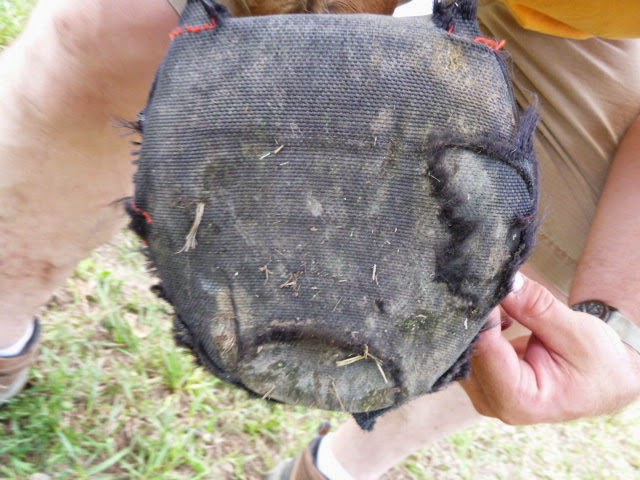 |
| Bottom of the wrap after about a week of use, without duct tape |
Another reason to like the wrap? Unlike most of the boots I looked at, I didn't have to know what size shoe Rufus wears, or take measurements, or order different ones for front and back. Hoof Wraps come in one size, which they say will fit 80% of horses. Just looking at one, I would not expect it to fit drafts, minis, or small ponies.
 |
Toe view of a well used wrap - this one I retired, but you can
see how the outer reinforcing layers had worn through.
The velcro fasteners were shot on this one by this point. |
On average, wraps lasted 2-3 weeks before the bottoms wore out. I did have to do some restitching on the front tabs of a couple of them, and I started reinforcing the toe area with bright pink duct tape, both for extra wear and for better visibility in case of loss.
 |
| Reinforced, for visibility and longer wear |
 |
| Still in use, but showing some wear. |
I've been so pleased with how well the wraps have preformed
I even wrote the company, to say how much I like them, which I almost never do.
Rufus in the wrap, walking - very brief
If I could make any changes, I would:
- Use stronger thread to attach the fasteners. (Those were what I ended up sewing back on on a couple of occasions).
- Make the fasteners and/or the wraps in bright colors to make locating lost ones easier I never would have guessed basic black would be so difficult to spot!
- Supply additional velcro stick-on squares with the replacement pads, because I always ran out of those before I exhausted my supply of pads. (Velcro does make a stick-on product that will adhere to flexible vinyl, but it can be tough to locate around here.)
Minor details aside, I would
highly recommend adding a Hoof Wrap to whatever emergency kit is in your barn or trailer for a quick, economical, easy to pack, temporary solution for stone bruises, thrown shoes, etc.


