I don't think it matters whether you're an English rider or a western rider, watching a talented horse & rider perform - or in this case a two pairs - is pretty amazing. Enjoy!
Showing posts with label reining. Show all posts
Showing posts with label reining. Show all posts
Sunday, January 22, 2012
No matter the discipline...
Cdncowgirl shared this over on Home on the Range (a great blog, for those of you who haven't happened across it), and I just had to share it here as well.
I don't think it matters whether you're an English rider or a western rider, watching a talented horse & rider perform - or in this case a two pairs - is pretty amazing. Enjoy!
I don't think it matters whether you're an English rider or a western rider, watching a talented horse & rider perform - or in this case a two pairs - is pretty amazing. Enjoy!


Friday, December 23, 2011
Lesson Day: Alisha, Take Two
Debated and debated over whether to take Sunny, but ultimately climbed into the Blazer rather than hook the trailer up. Arrived at Eric's with the sun still shining and no breeze - a balmy 32'. He asked if I wanted to ride outside. Glad I threw a heavier jacket in the car!
Alisha again - and this time I got to go collect her myself while Eric finished putting away his previous mount. She's outside with eight or ten other horses (and a couple of Eyore's cousins) in a big lot. Okay, first test: could I find the right horse? Catching one certainly wouldn't be a problem, as they all collect for their share of rubs and pats as soon as they see you coming - but haltering the right one might be a trick. I wended my way through, looking for a smallish, chestnut mare with one front stocking, and a blaze face perched on a long, upright neck... amid a corral full of chestnuts, bays and grays. Well, at least I could rule out the bays, grays, and the donkeys!
I haltered the horse that matched my best recollection of Alisha's build and markings, making sure to check underneath for the proper equipment - bringing in a gelding sure wouldn't get me any points for swiftness! I was fighting with the gate latch when Eric appeared to check on my progress. Happily for me, I had the right horse.
Saddled, bridled and booted all around, we headed out into the big arena for "show day" practice. Three small orange cones on the long side divided the arena into thirds - the middle was the center point, and a cone on each end about 10 feet off the short side denoted where I was to pretend the arena stopped.
After a brief warm-up we went straight into an easy left-lead lope, concentrating on cadence. My goal was to keep her steady and solidly on a big circle encompassing about half the arena - the center being that middle orange cone. All changes of rate were to happen at the exact center on a straight mid-line.
After I'd successfully circled the arena several times, being coached on relaxing deep into my seat and not dropping my shoulders, and oh, by the way, she doesn't like the greenhouse at that end, so be sure to work to keep her round... Eric had me collect her up and ask her for fast, large circles. As we sped around the arena, concentrating on maintaining cadence and circularity (no egg-shapes, please!) he explained the small slow circle that we'd transition to next.
The small slow circle begins on the same imaginary mid-line as the large, fast circle, but it's smaller (duh!). The goal is to show the largest difference possible between the rate of the large fast and small slow - but cadence, roundness and smoothness trump all.
When I asked for slow, I unintentionally shifted my weight - and got a huge bounce right - note to self: Alisha changes leads on the fly really(!) fast - as she misinterpreted my seat adjustment as a signal to switch directions. Oops. Misplaced cues aside, we managed a series of size and rate changes fairly well, although I suspect there was lots of room for improvement. Still, for a first effort I don't think it was too bad.
Following circles to the left we paused to allow Alisha (and me) to air up again, then repeated the exercise to the right at the other end of the arena. This time, a clearer ideas of what was expected things went more smoothly, so we didn't work in that direction quite as long.
Another pause for breathing during which Eric demonstrated flying lead changes. The smaller indoor doesn't have enough space for practicing those, so although my circles could probably have used more work on roundness and definitely on rate, the daylight was starting to trickle away, taking with it any lingering warmth - we moved on to make the most of the unusual-for-this-time-of-year gift of outdoor space.
Hopefully this makes sense - it does in my head, but once it's passed through my fingers, all bets are off! Eric's intent in training is that a horse will maintain it's rate and direction on the circle with the lightest possible guidance from the rider. Because the horses quickly learn the patterns and to respond to shifts of weight and leg position lightly and promptly (witness Alisha's quick bounce anticipating a lead change when I shifted my hips), it's important to cue them clearly and consistently when a change is actually coming. Well, all the time, actually, but you get the idea.
So. On a normal circle left with no change planned, my legs should be steady, maintaining light to non-existent support, only bumping if Alisha's rate changes or she moves off the circle. On a left circle preparing for a change, rounding the curve just prior to the center, I should add right (outside) leg behind the cinch, reinforcing a haunches-in. At the center I should change to a cue for the right lead. I should be looking up and to the center of the new circle. My weight should shift from my right to left hip, and my right leg should move forward to hold her barrel, with my left leg sliding back behind the cinch to move her left hip over, while my right hand lifts to tip her nose in, cuing a bend into the curve of the new circle.
She should change smoothly, not bolting forward into the new direction - which she had a tendency to do. But that's mostly a sign that I haven't quite gotten the hang of how much emphasis (not much) I need to cue her. I'm still shouting, or at least asking loudly; I need to learn to whisper.
A couple of changes in both directions provided plenty of food for thought. As the daylight was fading more quickly, we finished up with another run at spinning properly. Lo and behold! My slow, thoughtful body-part-by-body-part practice on Sunny paid off. I wouldn't say the spins were fantastic, but they were much better. And I was able to focus more successfully on Aisha, enough to tell when she was correctly stepping over to the right in front, or incorrectly stepping under. I'm not sure how big my grin was, but I know I was wearing one!
We called it a ride with that - a very successful lesson on multiple counts. I made it through without being uncomfortably nervous at the speed we were traveling much of the time, AND I managed to successfully and intentionally cue for flying changes. As a bonus, the spins have improved.
I may feel guilty for cheating on Sunny, but it is nice to have the opportunity to learn without splitting my attention between what I'm doing and what he should be doing but isn't. And I was doubly grateful I hadn't brought him when, after walking Alisha mostly cool and brushing her to the point of barely damp, Eric decided that she should spend the night in the barn were it was warmer, rather then going back out into the increasingly chilly night temps.
Saturday, December 17, 2011
Lesson Day: Alisha
Thursday afternoon it was again too cold for me to want to haul Sunny. I layered on long underwear under my boots and jeans and headed over to Eric's to see who he'd have me ride. No choice this time - when I arrived sans-pony, he informed me we were going to work on reinforcing muscle memory from last week.
But instead of riding Pride, who was going to make me work for everything, he put me on Alisha. Alisha, like many of Eric's horses, has competed successfully on a national level. In her case, in several disciplines, including saddleseat and reining. A very sweet mare, he described her as an over-achiever. If I was clear about what I wanted, she'd be spot on - if not, she was going to get anxious. She has an upright build and a long, elegant neck - instead of having to work on elevation and getting lightness in front like I do with Sunny and had to with Pride, I'd have to work on solid cues and keeping her collected.
He had me warm up hunt, with trotting transitions (and if that wasn't just a barrel full of monkeys in a western saddle!), haunches in/out and then we worked on walk/lope transitions, stops and rollbacks. Transitions were MUCH easier - primarily because she's so light and forward that I could almost think her into a lope. But she'd also happily pick up the wrong lead, so it was pretty clear if I was asking correctly or not.
Stopping was tougher - Alisha doesn't have sliders on, so the effect was a harder stop since all forward motion ceased immediately rather than continuing on into the slide as it did with Pride. I managed to sit one decent stop - the last one, but overall had a really hard time not automatically bracing my lower back rather than melting down into my seat. Just like with the spins last week, sitting the stop was much easier if I remembered to look up, rather than down. Just rocking my head and shoulders back let Alisha lift her front end and tuck her butt properly. And kept me from imitating a lawn dart.
Spins... still figuring those out. Alisha has a club foot on the left front. Shorter tendon/ligament? Eric explained and I didn't retain the technicalities. Suffice it to say that she's trimmed well, and it doesn't affect her moving, except when she spins - because it's harder for her to go right, if she's not moving slightly forward when she starts, she'll step under rather than over in front. Since she spins like she does everything else - fast, I had trouble keeping up with her to the left. But to the right because of her conformational defect, she's just a little slower.
From my point of view, that was not a bad thing - it was relatively speaking easier for me to at least try to get all my bits properly organized going right. I'm almost getting the proper cluck-then-bump rhythm down...almost, but not quite. But it's coming.
I actually practiced spinning very slowly, bareback, on Sunny yesterday, thinking about getting each of both of our body parts to move when I wanted them to. Not that he had much of a clue, or that it would have resembled a spin to anyone watching us, but I think it helped me at least, and he's a trooper. It's going to take some work - this is going to be another one of those maneuvers like the half-pass that should be simple, but where I get my rights and lefts all discombobulated.
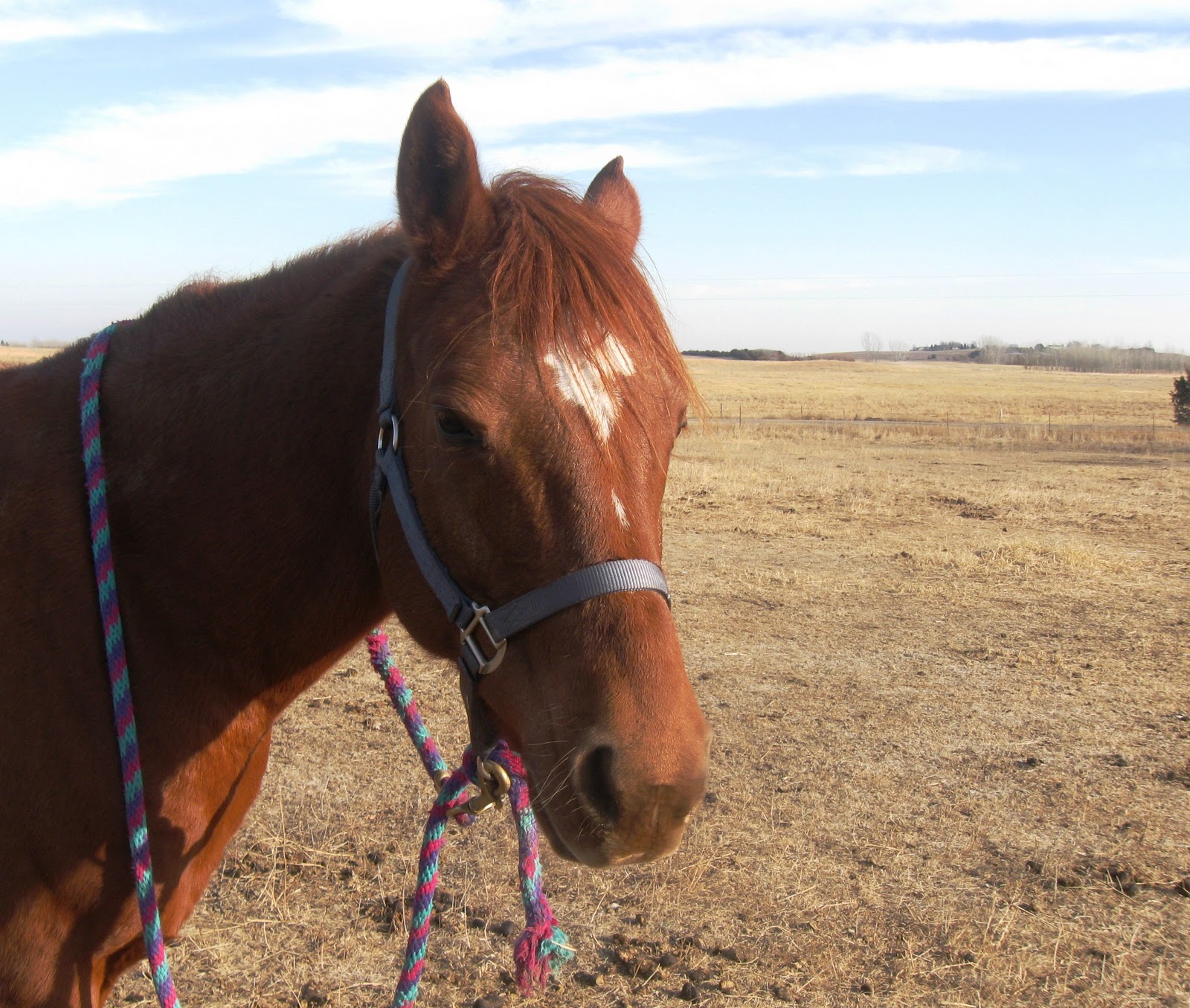 |
| Is that not a patient face? |
Friday, December 9, 2011
Riding the Slide
Lesson day yesterday, but it was just too cold to get Sunny all sweaty again. He'll get his turn this weekend, outside in the sunshine on the trail.
I had my choice when I arrived - since this is a down period for lessons (apparently not too many people are interested in riding in the cold... go figure!) and the wind-up for show season hasn't started yet, the barn is pretty quiet. I could pick: hunt seat, English pleasure, western pleasure, or a reiner. English pleasure is so far out of my arena that I wouldn't know where to begin - I opted for a reiner.
Eric had me get Pride out. He's a cute little bay Arab; fine-boned and delicate with a compact build. Very catty and light on his feet. And very narrow after Sunny's barrel-shape.
Tacking up was western, of course. A simple O-ring snaffle and blue leg wraps. Eric demonstrated the proper method on the fronts, and had me do the rears. Something I've always wanted to learn, but have been afraid to try on my own for fear of screwing it up. Very cool.
From memory, so hopefully right - I'm going to have to practice!
Once Pride was dressed, Eric put us through the usual warm-up exercises, which also served as an opportunity to get connected. Riding a finished horse, it's amazing the difference in balance and cadence - and lightness. He was a bit fresh to start with, but forward is good, and he was cooperative about it, so no worries there. Is it comforting, or disheartening to know that I can consistently muck up a sidepass on a horse that actually knows what he's doing? Sigh...
So. Other than the saddle, there are a few definite differences between hunt seat and reining. In a nutshell:
Oddly, although I struggled as usual with lope departures, stopping that hard felt fairly natural. Other than forgetting to say "whoa" a couple of times, and getting slightly stiff and rocking forward once, sitting deep, relaxed, and pushing my feet forward into the slide felt fine. Unlike riding Sunny, where I struggle just to keep him from breaking back to a trot, and whose balance on a circle is still developing, Pride patters neatly around. Asking him to speed up is as simple as moving your hands forward and driving with your hips, leg and seat. Want to slow down? Slow the rate of your hips. Stop? Take your legs off and remember to say, "Whoa!"
Loping off was a challenge, though. Ideally, from a collected walk with the horse bent slightly on the circle, I would cue for the lope by tipping his nose in and sliding my outside leg back, then squeezing with both legs and kissing. And he should step nicely up into a lope. Except not... or at least not consistently. Ultimately, we determined that I was being too busy with my hands and legs in preparing for the transition. If I kept everything crisp and clear, he'd step up. If I monkeyed with trying to get him perfectly in frame and moving forward, he was getting so many signals he just ignored me. I suspect I've been doing the same thing with Sunny. And believe me, I was making mental notes!
Spinning... Do you get dizzy easily? Here again, right and left were not my friends, but I managed to successfully coordinate myself to get a couple of decent efforts. And actually, I learned as much from doing things wrong - I was having a horrible time to the left. Until I shifted my weight back and suddenly Pride was spinning. With my weight off his shoulders he was able to rock back on his hindquarters properly.
It didn't feel as if I worked as hard as I usually do with Sunny, and Pride certainly wasn't as sweaty, but I'm pleasantly sore this morning in some interesting places. Different muscles at work, quite definitely! And I'm looking forward to using them again!
I had my choice when I arrived - since this is a down period for lessons (apparently not too many people are interested in riding in the cold... go figure!) and the wind-up for show season hasn't started yet, the barn is pretty quiet. I could pick: hunt seat, English pleasure, western pleasure, or a reiner. English pleasure is so far out of my arena that I wouldn't know where to begin - I opted for a reiner.
Eric had me get Pride out. He's a cute little bay Arab; fine-boned and delicate with a compact build. Very catty and light on his feet. And very narrow after Sunny's barrel-shape.
Tacking up was western, of course. A simple O-ring snaffle and blue leg wraps. Eric demonstrated the proper method on the fronts, and had me do the rears. Something I've always wanted to learn, but have been afraid to try on my own for fear of screwing it up. Very cool.
From memory, so hopefully right - I'm going to have to practice!
Wrap to the inside.
The roll should unwrap counterclockwise,
or the velcro fastener will be backwards when you finish the wrap.
It should be snug, but not tight, with no wrinkles.
Start just below the knee on the cannon bone and wrap downwards,
lapping about halfway down each time.
At the bottom of the cannon,
take a wrap down under the bulb of the fetlock,
around once, and then back down
under the bulb once more.
The wrap should have a small V in the middle/front
of the leg if done properly.
Then wrap back up to the top of the cannon bone again
to finish the where it started.
Once Pride was dressed, Eric put us through the usual warm-up exercises, which also served as an opportunity to get connected. Riding a finished horse, it's amazing the difference in balance and cadence - and lightness. He was a bit fresh to start with, but forward is good, and he was cooperative about it, so no worries there. Is it comforting, or disheartening to know that I can consistently muck up a sidepass on a horse that actually knows what he's doing? Sigh...
So. Other than the saddle, there are a few definite differences between hunt seat and reining. In a nutshell:
- Hunt: lots of trotting - sitting and posting
- Reining: no trotting. It's either walking, loping or galloping
- Hunt: seat is centered or forward.
- Reining: seat is deep and balanced, but never forward.
- Hunt: stop is round, collected, and legs stay on through the entire downward transition, only coming off when the stop is complete.
- Reining: stop is round, collected, and the stop comes through your seat - when your leg comes off their sides and forward, the horse stops. And when you're preparing for a stop, you go faster.
Oddly, although I struggled as usual with lope departures, stopping that hard felt fairly natural. Other than forgetting to say "whoa" a couple of times, and getting slightly stiff and rocking forward once, sitting deep, relaxed, and pushing my feet forward into the slide felt fine. Unlike riding Sunny, where I struggle just to keep him from breaking back to a trot, and whose balance on a circle is still developing, Pride patters neatly around. Asking him to speed up is as simple as moving your hands forward and driving with your hips, leg and seat. Want to slow down? Slow the rate of your hips. Stop? Take your legs off and remember to say, "Whoa!"
Loping off was a challenge, though. Ideally, from a collected walk with the horse bent slightly on the circle, I would cue for the lope by tipping his nose in and sliding my outside leg back, then squeezing with both legs and kissing. And he should step nicely up into a lope. Except not... or at least not consistently. Ultimately, we determined that I was being too busy with my hands and legs in preparing for the transition. If I kept everything crisp and clear, he'd step up. If I monkeyed with trying to get him perfectly in frame and moving forward, he was getting so many signals he just ignored me. I suspect I've been doing the same thing with Sunny. And believe me, I was making mental notes!
Spinning... Do you get dizzy easily? Here again, right and left were not my friends, but I managed to successfully coordinate myself to get a couple of decent efforts. And actually, I learned as much from doing things wrong - I was having a horrible time to the left. Until I shifted my weight back and suddenly Pride was spinning. With my weight off his shoulders he was able to rock back on his hindquarters properly.
It didn't feel as if I worked as hard as I usually do with Sunny, and Pride certainly wasn't as sweaty, but I'm pleasantly sore this morning in some interesting places. Different muscles at work, quite definitely! And I'm looking forward to using them again!
Sunday, November 20, 2011
Reining, Cutting and Working Cow @ the Ranch of Cherry Creek
Yesterday was an education.
In a good way!
Apparently, Eric (who I've been taking lessons from) periodically arranges some sort of field-trip or clinic for his students. His goal is an opportunity to spend the day learning about an aspect of the horse or show world most of us didn't have much experience with. Eric's students include a lot of young riders (and a few of their parents), and most of his younger students ride and show hunt seat or English pleasure, so this particular excursion really was a brand new experience for the majority, including me - and it was a huge treat.
Don Ulmer, long-time reining, cutting and working cow-horse trainer and sometime judge generously volunteered his time and expertise (and facility) for a demonstration and hands-on learning opportunity. Not so much a clinic, exactly, as an introduction to the world of reining, working cow and cutting horse competitions.
His audience was initially supposed to be about 40 strong, but inclement weather unfortunately - or fortunately, depending on how you look at it - cut the number by about half. About 10 youth riders of various ages and their parents, and assorted others of us beyond our teens made the trek up to the Ranch of Cherry Creek in spite of blowing snow, wind, and some of the coldest temps we've seen yet this winter. Thankfully, the barn was heated, and the huge - 150'x300' - indoor arena while not exactly warm, was comfortable as long as I was moving or wrapped around my coffee mug.
The facility itself is gorgeous and practical - a barn runs along the outside of the arena wall down one full side. 30+ (I didn't count) 12'x12' box stalls line both sides of the wide aisle, with offices, a kitchenette, bathrooms and a tack room facing a row of stalls on one end. It's all very light, airy and open feeling, helped out because the stalls are bars on all sides from about counter-height up. A couple of us wandered the barn aisle oohing and aahing over the lovely brass plates identifying each resident, the stalls themselves, how comfortable and content all the horses looked, and how clean and neat everything was. It's not a boarding/lesson barn, it's a one-owner training facility, and it was definitely an impressive operation.
The day started at 10 AM (although since I rode up with Eric and a couple of others and he hauled the horses, it actually started a lot earlier) with Don and his daughter and fellow trainer Elise demonstrating the basics of their warm-up, what the elements of a reining pattern consist of and how they can be combined, riding for training purposes and a couple of "show" patterns, followed by an explanation of how the pattern would be scored. After that they gave us a cutting demo (on a very fresh pen of cows) and a scoring explanation, and then showed us the after-the-box portion of a working cow horse run, again with an explanation of scoring.
Along the way, Don explained what makes each event different, how they prepare, what makes a good, better, best run, and how and why the horses need to carry themselves the way they're encouraged to. His explanations were very thorough - we didn't have too many questions, but it was a shade chilly sitting still, so perhaps we were all just slightly frozen....
After lunch (broasted chicken, potatoes, macaroni salad, cookies and lots of hot coffee) the hands on portion of the program started.
Along the way...
Don's philosophy of training and horsemanship encompasses several things. I'm going to paraphrase wildly here, since I wasn't taking notes, so these are a few of the statements that stuck with me at least as I interpreted them.
- It isn't possible to MAKE a horse do anything, at least not productively, for very long.
- You need to ride the horse, the horse shouldn't ride you. Elaborating on this point, he explained that every step the horse takes when you're on him should be intentional on your part.
- Correction isn't about making something painful - horses remember pain and it makes them stiffen up. A stiff horse isn't a fluid, flexible horse.
- Find the job that suits the horse, and your life - and theirs - will be much easier.
- What suits the horse isn't necessarily going to be what he/she was bred for.
- A horse has five parts - head, neck, shoulders, barrel/ribcage and hip. You have to be able to move them all where you want to when you want to, or you aren't riding the whole horse.
- You have to ride the whole horse - if you only depend on your reins to control your horse, and your hand is halfway up his neck, you're only riding 10% of him. (And if you can win while riding 10% of the horse, he'll buy him, because when the other 90% of the horse gets involved, he'll be a universe-beater - lol!)
- At some point you have to trust your horse. If you can't, you may need to find a horse you can trust.
After lunch they saddled six or seven horses along with another two that Eric brought along. These were their show horses, and not just any old show horses, either - check out the Winner's Circle page. Current national and reserve national champions Dakota Wolf, RCC Reinman, Quintessa, and Short and Smart, along with past multi-time champion and reserve champions Traddition and a couple of others whose "official" names I didn't catch. Since not as many of us as originally planned were there, everyone who wanted to got a chance to try cutting one or two cows while Don and Elise turned back and coached. For the most part, it appeared to be a matter of not overriding. Those horses knew their jobs, and the riders that sat tight and stayed out of their way did better than the ones that tried to do too much of the thinking.
For anyone who doesn't know - which until yesterday, included me, if you take your hand off your horse's neck when you're cutting a cow, you lose points. So the idea is to let your horse work the cow, and only provide an miniscule amount of guidance needed with by shifting weight, and using your seat and legs. Lifting your hand cues your horse that you're done. Meaning that if the horse doesn't really want to work a cow, you're in deep digested-by-cow-already product.
Then they set up the flag. On a pulley system strung from one end of the arena to the other across the short end of the arena, it's set up at cow height, and stands in for a cow for practice purposes. We all had a chance to try that - again, once locked on to the flag, no hand lifting involved, and you always cue the horse with the leg closest to the flag/cow. So if you want your horse to turn left, you kick with the left heel - which seems counter-intuitive, but that's how they're trained.
Eric had me riding Aslan, one of his horses, an ex-junior reining champion. Aslan hasn't been finished in the bridle, so he's still in two reins (which I'm fine with) and he's never seen cows. But he's extremely solid on all of the maneuvers Eric's had me working on with Sunny, so I had an excellent opportunity to practice those. The arena was so big that those of us waiting our turn still had a normal arena-sized area to ride in while the action was going on on the other end. We could either watch or ride - I really wanted to watch, but I also didn't want to freeze, since I'd shed my heavy jacket to ride. So I'd watch until I got chilly, then practice some more with Aslan until I was warm again.
Since Aslan hadn't seen cows before - although he was definitely interested, not spooked - I didn't try cutting. But I did get to try spinning, which was a lot of fun. And later on I switched horses and tried chasing the flag, which was absolutely cool on a stick. For the most part I managed to remember to keep my hand down, and I kept my seat on the catty gelding I was on pretty well. Remembering (and finding a chance) to breathe was definitely a challenge, though!
What I walked away with:
I can safely say that working cow horse is probably NOT in my future. I'm not the adrenaline junkie that sport's need-for-speed enthusiasts seem to be. Reining... there's a lot of speed there, too, but since ease and control are the primary focus, I'm thinking I could maybe work up to that. Cutting has always looked like fun, and yesterday was no exception. But I'd need a different horse, as Sunny doesn't seem to have a lot of interest in cows, so for the time being that's probably out.
A better appreciation for why western horses' head carriage is low. But this is getting long, so more on that later.
Overall it was a fantastic day, and the Ulmers get my whole-hearted thanks for hosting us and sharing their time, horses, and knowledge.
It didn't feel like I did a whole lot beside listen and absorb, but when I finally got home yesterday evening I heated up a bowl of left-over chilli, and managed a whole half-hour on the couch with the cats before I fell asleep. I woke up when the program I wasn't watching ended, brushed my teeth, and crawled into bed at 8:35 PM. Proving yet again that learning IS exhausting - lol!
Subscribe to:
Posts (Atom)